As someone with dyslexia, I often find that people have a lack of understanding about the learning difference and their perspective on our struggles is limited. My Dad also has dyslexia and through years of stories (my dad being a master storyteller) I have learnt about how his experiences with dyslexia has greatly impacted his life.
Inspired by these stories I have created a visual text piece, discussing the impact that dyslexia can have on an individual’s self-esteem, education, and employability. Although informed by my Dad’s speech patterns, stories, and experiences, ultimately it a highly fictionalised piece of work exploring the impact that dyslexia can have on someone’s life, especially when they have not received the help they deserve.
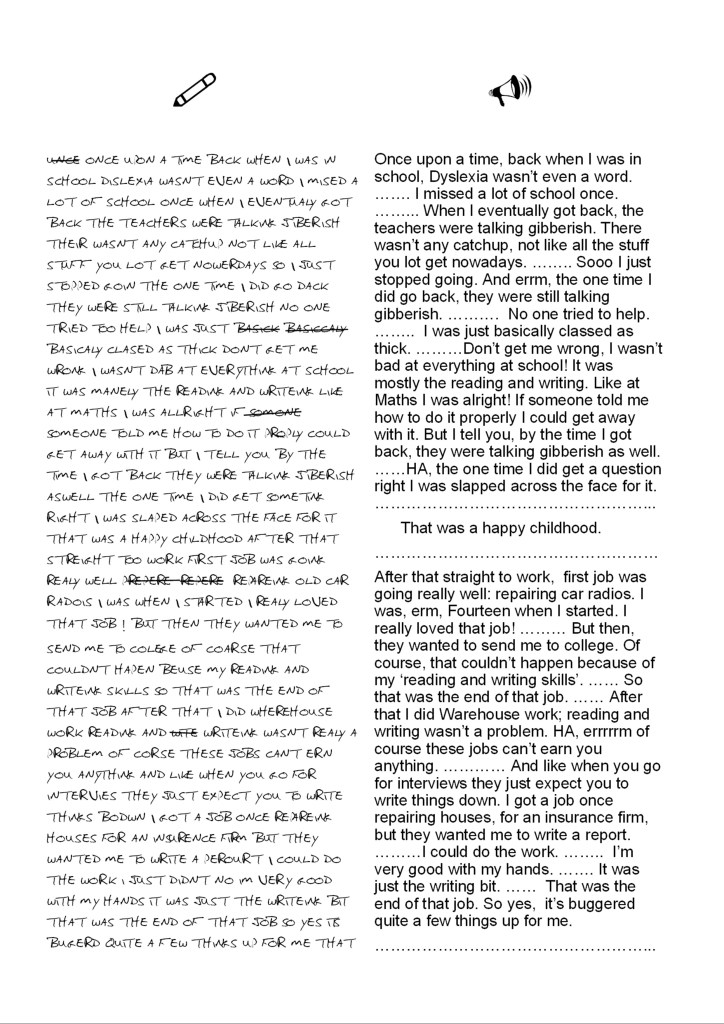

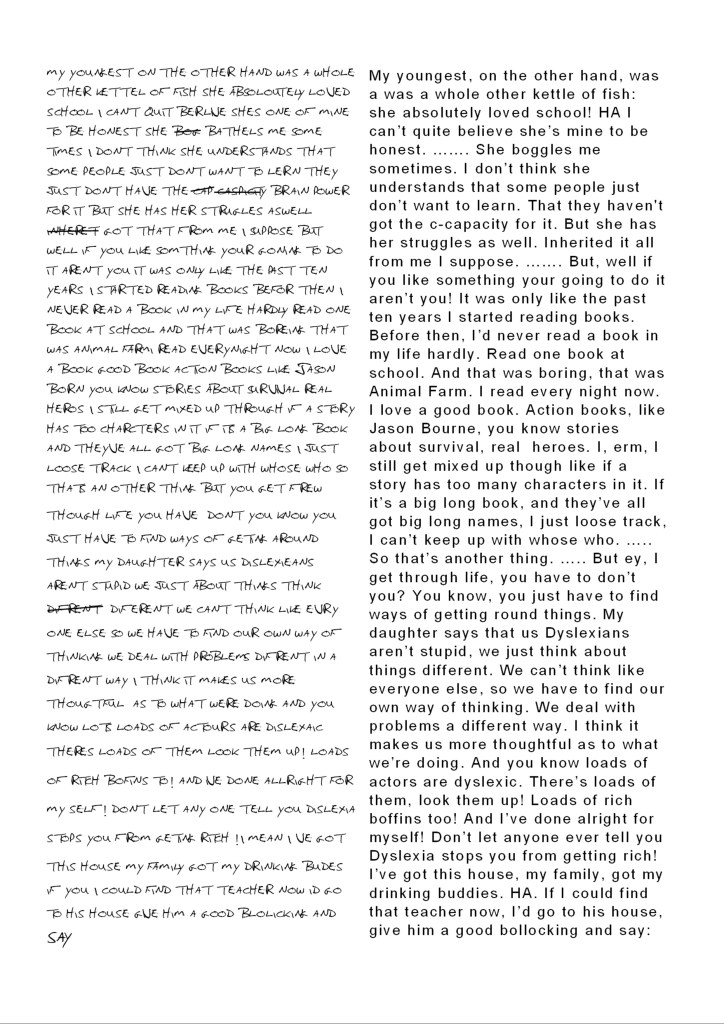

Now that you have read the piece I want to talk a little more about some of the visual elements I choose to include.
I split the page into two: a written side (left) and a spoken side (right). With the spoken side, I wanted to create a voice that sounded authentic to the way my dad talks. I used visual elements to show his speech patterns: for pauses I used ellipsis of varying lengths depending on the length of pause, for laughter I used ‘HA’ in different sizes to convey his varying levels of confidence (for example: small ‘HA’ for an awkward under the breath laugh and large ‘HA’ for confident laughter in reaction to a genuine joke), and I used the spacing between words to suggest the speed with which they are spoken. For example, with the ‘Once upon a time’, at the beginning, the letters are spaced widely apart from each other to show that it is said in an elongated way, something that my dad often does for dramatic effect (as I said, he is a storyteller).
The written side is misspelt and difficult to read; the combination of this messy handwriting and the use of crossing out is intended to show how difficult and stressful writing whilst dyslexic can be (writing this now I can relate to this, having to frequently google spellings and knowing I will need someone to proof read this before publishing).
With the dissolving of language at the end of the piece, as the letters fall the reader is prompted to question our reliance on written language and how someone who struggles with it can be rendered voiceless. This is in contrast to the confidence suggested from the clear font on the spoken half, as for my dad storytelling is a form in which he feels most comfortable.
I hope that in reading my piece I have shared with you some insight on what being dyslexic can be like. But please remember no one person’s experience with dyslexia is the same. Being dyslexic is a part of who I am and although it brings with it many difficulties, it also makes me think outside the box, helps me think more holistically, and helps with my creativity.
As I always say to my dad: we are not stupid, we just think about things in a different way.
You can find out more about dyslexia at www.bdadyslexia.org.uk
 laurentemplepoet.co.uk